|
CGiV2013 - 10th International Conference www.graphicslink.co.uk/cgiv2012/
University
of Macau● Macau S.A.R. ● China www.graphicslink.co.uk/cgiv2013/VENUE.htm Keynotes
Lectures: |
|
Visualization
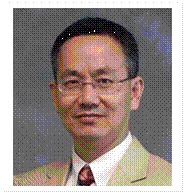
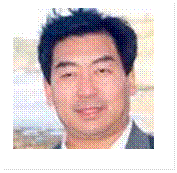
of Hierarchical Information on Mobile Screens Professor Kang Zhang Professor and Director of Visual Computing Lab The University of Texas at Dallas,
USA Abstract: Visualizing and exploring a hierarchical structure on
small screen devices, such as mobile phones, is a challenge. On the screens
of desktop PCs and laptops, such hierarchical structures are often shown in a
tabular view. Due to the size particularly the width restriction, a tabular
view is not suited for mobile screens. This talk discusses a visualization
technique that displays multiple levels of a hierarchy on a single view and
allows users to explore the hierarchical structure rapidly through touch
input. The visualization technique makes full use of the available space and
flexibly allocates the space for individual nodes according to the
application criteria. The approach adapts the selection and display of
relevant information based on the user’s query habit, by hiding less
important information to maximize the utilization of the space. We
have conducted a user study to compare our visualization and navigation
approach with the list-based approach on most of the current mobile phones,
and will report our findings.
 |
|
|
Presenting Heritage in Large-scale
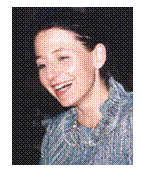
Immersive Environments Sarah Kenderdine Visiting Assoc. Prof. CityU, Hong Kong;
Director: Centre for Innovation in Galleries, Libraries, Archives and Museums
(iGLAM) Director of Research: Applied Laboratory of Interactive Visualization
and Embodiment (ALiVE) Special Projects: Museum
Victoria Abstract: This presentation examines new paradigms for
developing cultural heritage archives as embodied museum experiences. Using
heterogeneous datasets representing intangible and tangible heritage, Sarah
Kenderdine, explores interactive applications inside a series of fully
immersive visualization systems. The Migration of Aura engages contemporary
museum discourses and the concept of aura with virtual, interactive and
augmented reality technologies. The installations described in this lecture
include world heritage sites of Angkor in Cambodia, Dunhuang
in China, the Monuments at Hampi in South India and
numerous sites throughout Turkey. The research discussed also involves
visualization of cultural collections and web-based archives from Europeana (the world’s largest cultural collection online
with 22 million objects) and the digitized Korean Buddhist Cannon (Tripitaka Koreana) in Haeinsa, Korea. Two works based on Pacifying of the South
China Sea Pirates’ scroll painting recently created for the new Maritime
Museum, Hong Kong (2013) will also be described <
http://alive.scm.cityu.edu.hk/ >.
|
|
|
Simulation of Various Interactions
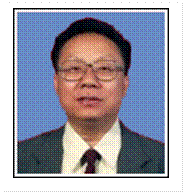
in Fluid Dynamics Professor Enhua Wu Faculty of Science and Technology, State Key Lab of Computer Science,
Chinese Abstract Fluid phenomena and fluid interactions are common in
our daily life. As a challenging topic, the interactions on fluid dynamics
are involved with highly comprehensive behavior simulation. We will in the
talk classify the interactions into 2 categories, the internal and external
ones. For the internal interaction,
simulation to the mixture of multiple fluids in different features, both
immiscible and miserable, will be introduced, and solutions based on Lattice
Boltzmann Method (LBM) and conventional NSE solutions will be given. For the
external interaction, the behavior simulation of fluid dynamics with solid
objects including granular and fixed shapes, will be
introduced. All the interactive
behavior will be demonstrated by testing result of dynamics, and the
techniques for real time simulation in some situations will be also analyzed. Short
Biography
|
|
|
Visual
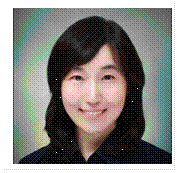
Analytics for Massive Complex Networks Professor Seok-Hee Hong School of Information Technologies, University of Sydney, Australia Abstract Recent technological advances have led to massive
complex network models in many domains, including social networks, biological
networks and webgraphs. Visualisation can
be an effective analysis tool for such networks. Good visualisation
reveals the hidden structure of the networks and amplifies human
understanding, thus leading to new insights, new findings and new hypothesis.
However, visualisation of
massive complex networks is very challenging due to scalability and
complexity. This talk will address the
challenging issues for visual analysis of massive complex networks, and
review latest methods for effective and efficient visual analytics of such
networks. In particular, integration
of good analysis method with good visualisation
method will be the key approach to solve the research challenge. Short
Biography
She serves as a Steering Committee
member of Graph Drawing Symposium, IEEE Pacificvis
Symposium, and ISAAC (International Symposium on Algorithms and Computation),
and an editor of JGAA (Journal of Graph Algorithms and Applications). She has
served as a Program Committee Chair of 6 international conferences, and a
Program Committee Member of 35 international conferences. In particular, she has formed the
Information Visualisation research community in the Asia-Pacific Region, by
founding the major conference (IEEE PacificVis Symposium). |
|
|
Interaction
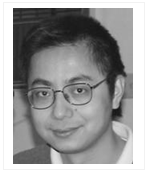
Design in Multi-Dimensional Visualization of Big Data Associate Professor Mao Lin Huang Director of Information Visualization Lab, The University of
Technology, Sydney, Australia Abstract: Big
data is a collection of large and complex data sets that are commonly appeared in
multidimensional and multivariate data formats and it becomes very difficult
to mine and present meaning knowledge from such data sets though the use of
on-hand data analysis and visualization techniques, due to its massive volume
and complexity (e.g. its multivariate format). Thus, there is an urgent need
to investigate more effective techniques to deal with such kind of huge data
sets. Currently there are several well-established geometrical systems for
visualizing multidimensional data that has been extensively studied for
decades. However, the existing associated visual interaction techniques
available are very limited. So far there is none existing techniques in
parallel coordinates visualization could well achieve the functions that are
covered by the ‘Select’ layer of J. S. Yi’s seven-layer’s interaction model.
This is because that the ‘Select’ of data items via mouse-click (and
mouse-over) operations over particular visual poly-lines (data item) with no
geometric region is theoretically impossible. In this talk, we will explore
the common issues and challenges raised in the design of visual interaction
process in multi-dimensional visualization, and then we will present a novel
technique that uses a set of ‘virtual nodes’ to practically achieve the
‘Select’ interaction, that has been proven as a theoretically impossible
operation, in parallel coordinates visualization. The proposed method is very
useful for big data visual analytics.
|
|
|
Data-Driven Photo Editing and Enhancement Professor Y.Z. Yu, The University of Hong Kong,
Hong Kong Abstract: Many hard problems become tractable with the
availability of large datasets. This is also true for digital photo editing
and enhancement. In this talk, I present two pieces of work in this category.
The first one is on data-driven image color theme editing, and the second one
on example-based color and tone enhancement based on learned styles. It is often important for designers and photographers
to convey or enhance desired color themes in their work. I present
a data-driven method for enhancing
a desired color theme in a digital photo. We formulate
our goal as a unified optimization that simultaneously considers a
desired color theme, texture-color relationships as well
as automatic or user-specified color constraints. Quantifying the
difference between an image and a color theme is made
possible by color emotion spaces. We incorporate prior
knowledge, such as texture-color relationships, extracted from a
database of photographs to maintain a natural look of the edited photos.
Experiments and a user study have confirmed the effectiveness of our
method. Color and tone adjustments are among the most
frequent image enhancement operations. In the second piece of work, our goal
was to learn implicit color and tone adjustment rules from examples. We
define tone and color adjustment rules as mappings, and propose to
approximate complicated spatially varying nonlinear mappings in a piecewise
manner. Parameters within such low-order models are trained using example
images. We successfully applied our framework in two scenarios, low-quality
photo enhancement by transferring the style of a high-end camera, and photo
enhancement using styles learned from photographers and designers.
|
|
|
| TOP | |